
Brain MRI in Seminole, FL
A brain MRI is the most detailed scan for headaches, memory concerns, dizziness, stroke, and other neurological symptoms. No radiation, no referral needed for self-pay, and same-week scheduling at our Seminole, FL imaging center — with optional NeuroQuant brain volumetric analysis.
What Is a Brain MRI?
A brain MRI uses a strong magnetic field and radio waves — no radiation — to produce highly detailed cross-sectional images of your brain and surrounding structures: the brain tissue itself, the blood vessels, the nerves, and the fluid-filled spaces. It is the single most sensitive test for evaluating the brain, because it shows soft-tissue detail that a CT scan often misses — making it the gold standard for headaches, memory loss, dizziness, seizures, and suspected stroke or multiple sclerosis. Most brain MRIs are performed without contrast; contrast (a gadolinium-based dye) is added only when your physician needs to evaluate a suspected tumor, infection, inflammation, or to look at blood vessels more closely. At AMI, brain MRIs can be paired with NeuroQuant — FDA-cleared AI software that measures the volume of brain regions like the hippocampus to support evaluation of memory loss and dementia.
What Can Brain MRI Diagnose?
- Causes of chronic or severe headaches and migraines
- Stroke, aneurysm, and bleeding in the brain
- Brain tumors and metastases
- Multiple sclerosis (MS) and other white-matter disease
- Memory loss, dementia, and Alzheimer's (with NeuroQuant volumetrics)
- Causes of dizziness, vertigo, and balance problems
- Seizures and epilepsy evaluation
- Pituitary, acoustic neuroma, and skull-base abnormalities
Brain MRI vs. CT Scan for Neurological Symptoms
For most non-emergency brain evaluation, MRI is the gold standard because it shows soft-tissue detail and uses no radiation. CT is faster and preferred in emergencies.
| Feature | AMI ✓ | CT |
|---|---|---|
| Soft-tissue detail | Excellent — best for brain tissue | Limited |
| Detects MS & subtle stroke | Yes — highly sensitive | Often misses |
| Radiation | None | Low-dose X-ray |
| Best for | Headaches, memory loss, MS, tumors, dizziness | Emergency bleeding, fracture |
| Self-pay from | $295 (without contrast) | From $295 |
How to Prepare for Your Brain MRI
- 1Remove all metal jewelry, piercings, watches, hairpins, and hearing aids
- 2Tell our technologist about any implants, pacemakers, aneurysm clips, or cochlear implants
- 3Wear comfortable clothing without metal zippers, buttons, or underwire
- 4Arrive 15 minutes early to complete intake and safety screening
- 5If using insurance, bring your insurance card and physician's order
- 6If you are anxious in enclosed spaces, ask about our Open MRI option
What to Expect During Your Brain MRI
Check-In & Safety Screening
You'll complete a safety questionnaire about any metal or implants in your body. Our technologist reviews your history and confirms whether contrast or NeuroQuant analysis is being added.
Positioning
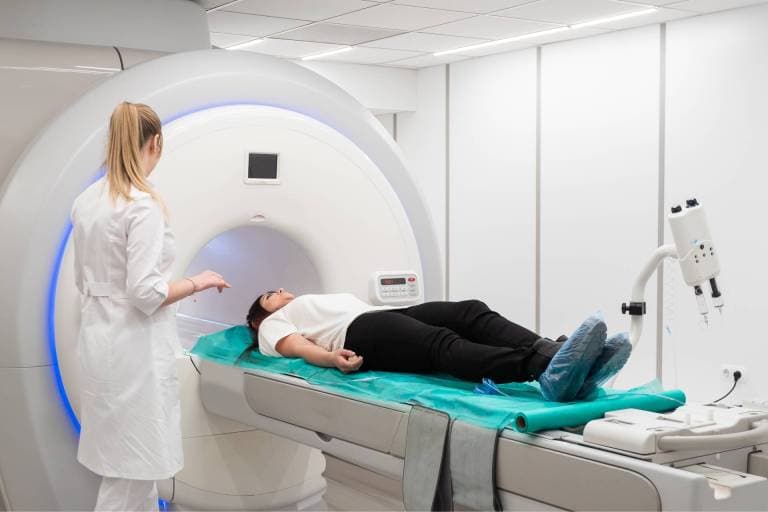
You'll lie on your back on a padded table that slides into the MRI. A coil is placed comfortably around your head. We'll give you earplugs or headphones with music to make you comfortable.
The Scan
You'll hear rhythmic tapping and humming — completely normal. The key is to keep your head as still as possible so the images are sharp. A typical brain MRI takes 30–45 minutes; adding contrast or NeuroQuant adds a few minutes.
After Your Scan
You can drive, return to work, and resume all normal activities immediately. A board-certified radiologist reads your images and delivers results to your physician within 48 hours; stat reads are available for urgent cases.
Frequently Asked Questions
Our self-pay brain MRI starts at $295 without contrast — up to 75% less than typical hospital pricing. Adding contrast or NeuroQuant brain volumetric analysis changes the price. Call (727) 398-5999 for an exact quote, or see our transparent self-pay pricing page.
Self-pay patients do not need a referral. Our physician reviews your request the same day — most self-pay patients are seen same day or added as a walk-in. If you plan to use insurance, a physician's order is still required, and we will verify your benefits before your appointment. Call (727) 398-5999 and we'll get you scheduled.
Most brain MRI exams take 30–45 minutes. A standard non-contrast scan is on the shorter end; adding IV contrast or NeuroQuant volumetric analysis can take a few minutes longer. We'll give you a time estimate when you schedule.
For most brain problems — headaches, memory loss, MS, tumors, and subtle stroke — MRI is more sensitive than CT because it shows soft-tissue detail and uses no radiation. CT is faster and is preferred in emergencies to quickly rule out acute bleeding or fracture. Your physician chooses based on your symptoms; for non-emergency neurological evaluation, brain MRI is usually the gold standard.
Most brain MRIs are done without contrast. Contrast (a gadolinium-based dye given through an IV) is added only in specific situations — to evaluate a suspected tumor, infection, inflammation, or to look more closely at blood vessels. Your physician and our radiologist decide whether contrast is needed.
NeuroQuant is FDA-cleared AI software that measures the volume of specific brain regions — like the hippocampus — from your MRI and compares them to normal ranges for your age. It is especially useful for evaluating memory loss, dementia, and Alzheimer's, and for tracking MS. It's optional; ask us or your physician whether it's right for your situation.
We understand MRI anxiety. Our wide-bore MRI gives extra space and we offer music during your scan. If you're very anxious, we also have an Open MRI option, or your doctor may prescribe a mild sedative. Let us know when you schedule so we can plan ahead.
Also Consider
See our transparent self-pay pricing (up to 75% less than hospital rates), or check accepted insurance plans. Comparing prices? Read our guide to MRI costs in Florida.
Ready to Schedule Your Brain MRI?
Call us or book online. We'll get you scheduled quickly.