

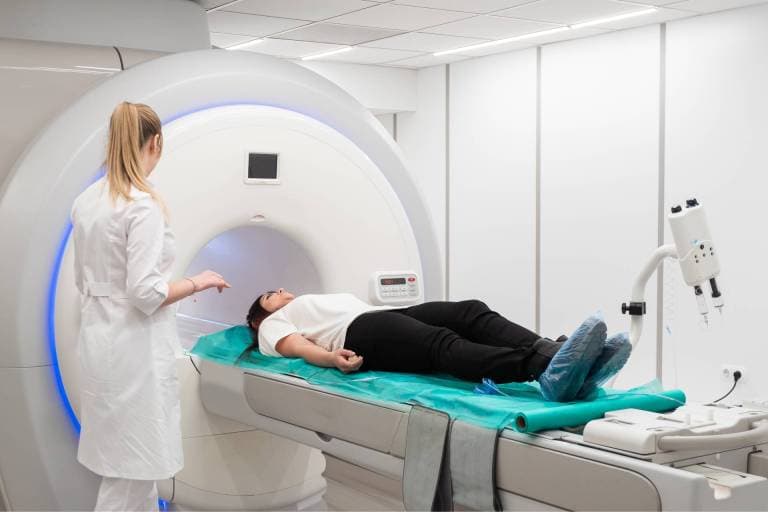
MRI in Seminole, FL
Our High-Field 1.5T MRI delivers exceptional diagnostic clarity for brain, spine, joints, and soft tissues — enhanced by Cortechs.ai NeuroQuant brain volumetrics and OnQ Prostate AI analysis. No radiation.
Also available at our St. Petersburg, FL location — 3T MRI only.
What Is a High-Field 1.5T MRI?
Magnetic Resonance Imaging (MRI) uses a strong magnetic field and radio waves to create detailed cross-sectional images of the inside of your body. Unlike X-rays or CT scans, MRI uses no ionizing radiation, making it one of the safest diagnostic imaging tools available. Our 1.5 Tesla High-Field MRI delivers superior image clarity compared to lower-field open systems, enabling our radiologists to detect even subtle abnormalities. Enhanced by Cortechs.ai AI software, our 1.5T MRI now supports NeuroQuant automated brain volumetrics and OnQ Prostate MRI analysis — the same technology used at leading academic centers.
What Can High-Field 1.5T MRI Diagnose?
- Brain conditions (tumors, stroke, MS, headaches)
- Neurodegeneration — Alzheimer's, dementia (via NeuroQuant AI volumetrics)
- Spine disorders (herniated discs, spinal stenosis)
- Joint injuries (rotator cuff tears, ACL tears, meniscus)
- Prostate cancer detection and staging (via OnQ Prostate AI)
- Abdominal and pelvic organ evaluation
- Vascular imaging (MRA of head and neck)
- Breast imaging (with and without contrast)
How much does an MRI cost in Seminole?
Published self-pay prices, radiologist reading included, no facility fee. Hospital outpatient MRIs in Pinellas County are commonly billed at $2,000 to $5,000 before insurance.
- MRI without contrastBrain, spine, joint, abdomen or pelvis$295
- MRI with and without contrastWhen your doctor orders gadolinium contrast$395
- Open MRISame price as the high-field scanner$295
- 3T MRI (St. Petersburg)With contrast $395$295
- Whole-body MRIScreening, no radiation$1,499
With insurance, your cost is your plan's copay or deductible; we verify benefits and handle the authorization before your visit. Self-pay patients do not need a referral. All prices →
Which MRI is right for you?
All three are read by the same board-certified radiologists and cost the same self-pay. Your doctor's order or your comfort usually decides.
High-field 1.5T MRI
The standard for most brain, spine, joint and body studies; wide-bore, with NeuroQuant and OnQ analysis available.
Seminole
Open MRI
Claustrophobia, larger patients, children, or anyone who needs a companion in the room.
Seminole
3 Tesla MRI
The finest detail for brain, prostate, cartilage and nerves, or when a specialist asks for 3T by name.
St. Petersburg
Ready to schedule your MRI?
Same-day appointments often available. No referral needed for self-pay.
How to Prepare for Your High-Field 1.5T MRI
- 1Remove all metal jewelry, piercings, watches, and hair clips
- 2Tell our technologist about any implants, pacemakers, or surgical hardware
- 3Wear comfortable clothing without metal zippers, buttons, or underwire
- 4Arrive 15 minutes early to complete intake forms
- 5If using insurance, bring your insurance card and physician's order
- 6If you are anxious about enclosed spaces, ask about our Open MRI option
What to Expect During Your High-Field 1.5T MRI
Check-In & Safety Screening
You'll complete a safety questionnaire about metal in your body. Our technologist will review your history and explain the entire process.
Positioning
You'll lie on a padded table that slides into the MRI machine. Our wide-bore design provides more room than traditional machines. We'll give you earplugs or headphones with music.
The Scan
You'll hear rhythmic tapping and humming sounds — this is completely normal. Stay as still as possible for the clearest images. The scan takes 30–60 minutes depending on the area being imaged.
AI-Enhanced Analysis
For qualifying brain and prostate studies, our Cortechs.ai platform automatically generates quantitative reports — NeuroQuant brain volume analysis or OnQ Prostate structured reporting — delivered alongside the radiologist's read.
After Your Scan
You can drive, eat, and resume all normal activities immediately. If contrast was used, drink extra water. Results go to your doctor in 48–72 hours (stat reads available for urgent cases).
Frequently Asked Questions
Yes. MRI uses magnets and radio waves — no radiation. It's one of the safest imaging techniques available. However, the strong magnetic field means people with certain metal implants or devices may not be eligible. Our team will screen you thoroughly before the exam.
Most MRI exams take 30–60 minutes. Some complex studies with contrast may take up to 90 minutes. We'll give you a time estimate when you schedule.
We understand MRI anxiety. Our wide-bore MRI provides extra space, and we offer music during your scan. If you're very anxious, we also have an Open MRI option, or your doctor may prescribe a mild sedative.
NeuroQuant is FDA-cleared AI software by Cortechs.ai that automatically measures the volume of brain structures — like the hippocampus — and compares them to age-matched norms. It helps detect early signs of neurodegeneration, Alzheimer's disease, and other brain conditions. It runs automatically on qualifying brain MRI studies.
OnQ Prostate is AI software that assists our radiologists in analyzing prostate MRI studies. It generates structured reports and highlights areas of concern, improving consistency and diagnostic accuracy for prostate cancer detection and staging.
For some exams, we inject a small amount of gadolinium-based contrast through an IV. This helps highlight certain structures like blood vessels, tumors, or inflammation. It's very safe — serious reactions are extremely rare.
Usually, yes — with screening first. Gadolinium MRI contrast is different from the iodine dye used in CT, so a prior CT-contrast allergy does not rule it out. If you have kidney disease, diabetes, or are over 60, we may check a simple kidney-function (eGFR) test before injecting; modern group II gadolinium agents are considered safe for most patients with reduced kidney function. Tell us about any allergies or kidney history when you schedule.
MRI is generally considered safe during pregnancy (no radiation), but we typically avoid it during the first trimester unless medically necessary. Always inform us if you are or might be pregnant.
Most insurance plans cover medically necessary MRI exams with a physician's order. We'll verify your benefits before your appointment. Self-pay pricing is also available with no referral needed — call (727) 398-5999 for details.
Self-pay at AMI: $295 for an MRI without contrast and $395 with and without contrast, including the radiologist's reading. Open MRI and 3T MRI are the same price. A whole-body screening MRI is $1,499. There are no facility or reading fees added later.
For self-pay, often yes: there is no insurance authorization to wait for. With insurance, it is usually the same week, depending on how quickly your plan authorizes the exam, which we handle for you. Call (727) 398-5999 for today's availability.
Self-pay patients do not need a referral: our physician reviews the request. If you are using insurance, your plan will usually require an order from your doctor.
Seminole (9555 Seminole Blvd) has the open and high-field 1.5T scanners plus CT, mammography, ultrasound, X-ray, DEXA and echo. St. Petersburg (2201 Central Ave) is a dedicated 3T MRI center. Both book through the same phone number and online form.
What We Scan
Our High-Field 1.5T MRI covers a wide range of body areas. Click any scan below for full details, prep instructions, and self-pay pricing.
Brain MRI →
Headaches, memory loss, dizziness, stroke & MS. No radiation. NeuroQuant available. From $295.
Spine MRI →
Back & neck pain, herniated discs, sciatica & stenosis. No radiation. From $295.
Knee MRI →
Knee pain, ACL/MCL tears, meniscus & cartilage damage. No radiation. From $295.
Shoulder MRI →
Rotator cuff tears, labral (SLAP) tears & impingement. No radiation. From $295.
Hip MRI →
Hip pain, labral tears, avascular necrosis & stress fractures. No radiation. From $295.
Abdominal & Pelvic MRI →
Liver, kidneys, pancreas & pelvic organs. No radiation. From $295.
Also Consider
See our transparent self-pay pricing (up to 75% less than hospital rates), or check accepted insurance plans. Comparing prices? Read our guide to MRI costs in Florida.
Ready to Schedule Your High-Field 1.5T MRI?
Call us or book online. We'll get you scheduled quickly.