

CT Scan in Seminole, FL
Our advanced CT scanner delivers high-resolution cross-sectional images in minutes — ideal for diagnosing injuries, infections, tumors, and vascular conditions. Same-day often available for self-pay.
What Is a CT Scan?
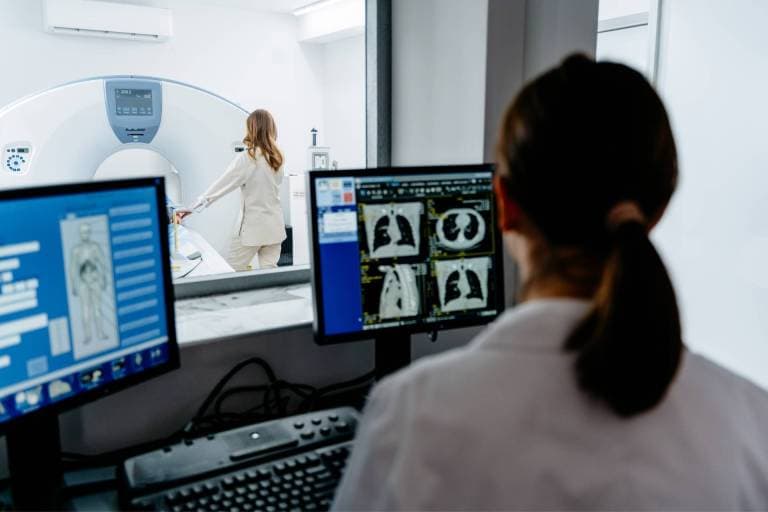
A CT (Computed Tomography) scan uses a series of X-ray images taken from different angles, combined by a computer into detailed cross-sectional views of your body. It's faster than MRI (most scans take under 15 minutes) and excels at showing bone detail, bleeding, blood vessels, and organ abnormalities. Our modern CT scanner uses low-dose protocols to minimize radiation exposure while maintaining excellent image quality.
What Can CT Scan Diagnose?
- Head injuries and stroke
- Chest and lung conditions (pneumonia, blood clots, lung nodules)
- Abdominal and pelvic pain (appendicitis, kidney stones, tumors)
- Bone fractures and spinal injuries
- Blood vessel problems (CTA for aneurysms, blockages)
- Cardiac calcium scoring (heart disease risk)
- Cancer staging and monitoring
- Lung cancer screening (low-dose CT)
How much does a CT scan cost in Seminole?
Published self-pay prices, radiologist reading included, no facility fee. Hospital outpatient CT scans in Pinellas County are commonly billed at $1,500 to $4,000 before insurance.
- CT without contrastHead, sinus, chest, abdomen, pelvis, spine or extremity$295
- CT with and without contrastWhen your doctor orders IV contrast$395
- Low-dose CT lung screeningAnnual screening for current or former smokers$150
- Coronary calcium scoreHeart-disease risk, no contrast, about 10 minutes$99
- Coronary CT angiographyBlockages and plaque, with contrast$395
With insurance, your cost is your plan's copay or deductible; we verify benefits before your visit. Eligible self-pay exams do not need a referral, and HSA/FSA cards are accepted. All prices →
CT, MRI or X-ray: which scan do you need?
Your doctor's order usually decides. If you are self-pay and choosing, this is how the three differ.
CT scan
Fast (under 15 minutes) and best for bone detail, lungs, kidney stones, bleeding and blood vessels. Low-dose X-ray radiation.
Seminole
MRI
Best for soft tissue: brain, spine, joints, ligaments and organs. No radiation; takes 20 to 45 minutes. From $295.
Seminole · St. Petersburg
X-ray
Fractures, chest, arthritis and joint alignment in a few minutes. $50 per body part.
Seminole
How to Prepare for Your CT Scan
- 1If contrast is needed, you may need to fast for 4 hours before the exam
- 2Tell us about any allergies, especially to iodine or contrast dye
- 3Inform us if you have kidney problems or diabetes
- 4Wear comfortable, metal-free clothing
- 5Arrive 15 minutes early; bring insurance card and physician's order if using insurance
- 6You may need to drink oral contrast liquid before abdominal/pelvic scans
What to Expect During Your CT Scan
Check-In
Complete paperwork and change if needed. For abdominal scans, you may drink oral contrast about an hour before the scan.
The Scan
You'll lie on a table that moves slowly through a donut-shaped scanner. It's open on both ends — not enclosed like an MRI. You may be asked to hold your breath briefly. Most scans take 5–15 minutes.
IV Contrast (if needed)
A small IV will be placed in your arm. You may feel a warm sensation or metallic taste for a few seconds when the contrast is injected — this is completely normal.
After Your Scan
Resume normal activities immediately. If you received IV contrast, drink extra water to flush it from your system. Results to your doctor in 48–72 hours.
Frequently Asked Questions
CT scans use a small amount of radiation, but our modern scanner uses low-dose protocols that minimize exposure. The diagnostic benefit almost always outweighs the small radiation risk. Our radiologists follow the ALARA principle — As Low As Reasonably Achievable.
The actual scan typically takes just 5–15 minutes. With check-in and prep (especially if oral contrast is needed), plan for about 30–60 minutes total.
A quick, non-contrast CT scan of your heart that measures calcium buildup in your coronary arteries. It's a powerful predictor of heart disease risk. The scan takes about 10 minutes and doesn't require any preparation.
Self-pay patients do not need a referral. Our physician reviews your request the same day — most self-pay patients are seen same day or added as a walk-in. If you plan to use insurance, a physician's order from your doctor is still required. Call (727) 398-5999 and we'll help you get started.
CT is faster and better for bone, bleeding, and lung imaging. MRI is better for soft tissues, brain, joints, and spine detail — and uses no radiation. Your doctor will order the right test for your condition.
Often, yes — with screening. CT contrast is an iodine-based dye, so tell us at scheduling about any prior reaction to iodinated contrast, kidney disease, or diabetes. Patients with kidney disease, diabetes, or age 60+ may need a quick eGFR blood test first. If you take metformin, we may ask you to pause it for 48 hours after the scan. A prior mild reaction can often be managed with premedication, and many CT exams — including calcium scoring and lung screening — need no contrast at all.
We avoid CT during pregnancy unless it is medically necessary and no radiation-free alternative will answer the question. Always tell our staff if you are or might be pregnant — ultrasound or MRI can often be used instead. If a CT is truly needed, low-dose protocols keep fetal exposure well below the level associated with any known risk.
A self-pay CT scan at AMI is $295 without contrast and $395 with and without contrast, radiologist reading included. A low-dose CT lung screening is $150 and a coronary calcium score is $99. Hospital outpatient departments in Pinellas County commonly bill $1,500 to $4,000 for the same scan.
If you are using insurance, yes: a physician's order is required and we handle the authorization. Eligible self-pay exams do not need a referral; call (727) 398-5999 and our team will confirm what applies to your scan.
For self-pay patients, often yes: same-day appointments are frequently available in Seminole, especially for scans without contrast. With insurance, it is usually the same week, once we verify coverage and any authorization comes through. Request a time online or call and we will confirm within one business day, usually sooner.
Also Consider
Imaging Without a Referral →
Self-pay patients can get a CT or MRI without a doctor’s referral — see how our same-day physician review works
High-Field 1.5T MRI →
CT or MRI? MRI is better for soft tissue, brain, joints, and spine — with no radiation
CT Cardiac Angiography with AI Analysis →
Add a calcium score or Cleerly AI plaque analysis for heart-disease risk screening
See our transparent self-pay pricing (up to 75% less than hospital rates), or check accepted insurance plans.
Ready to Schedule Your CT Scan?
Call us or book online. We'll get you scheduled quickly.