
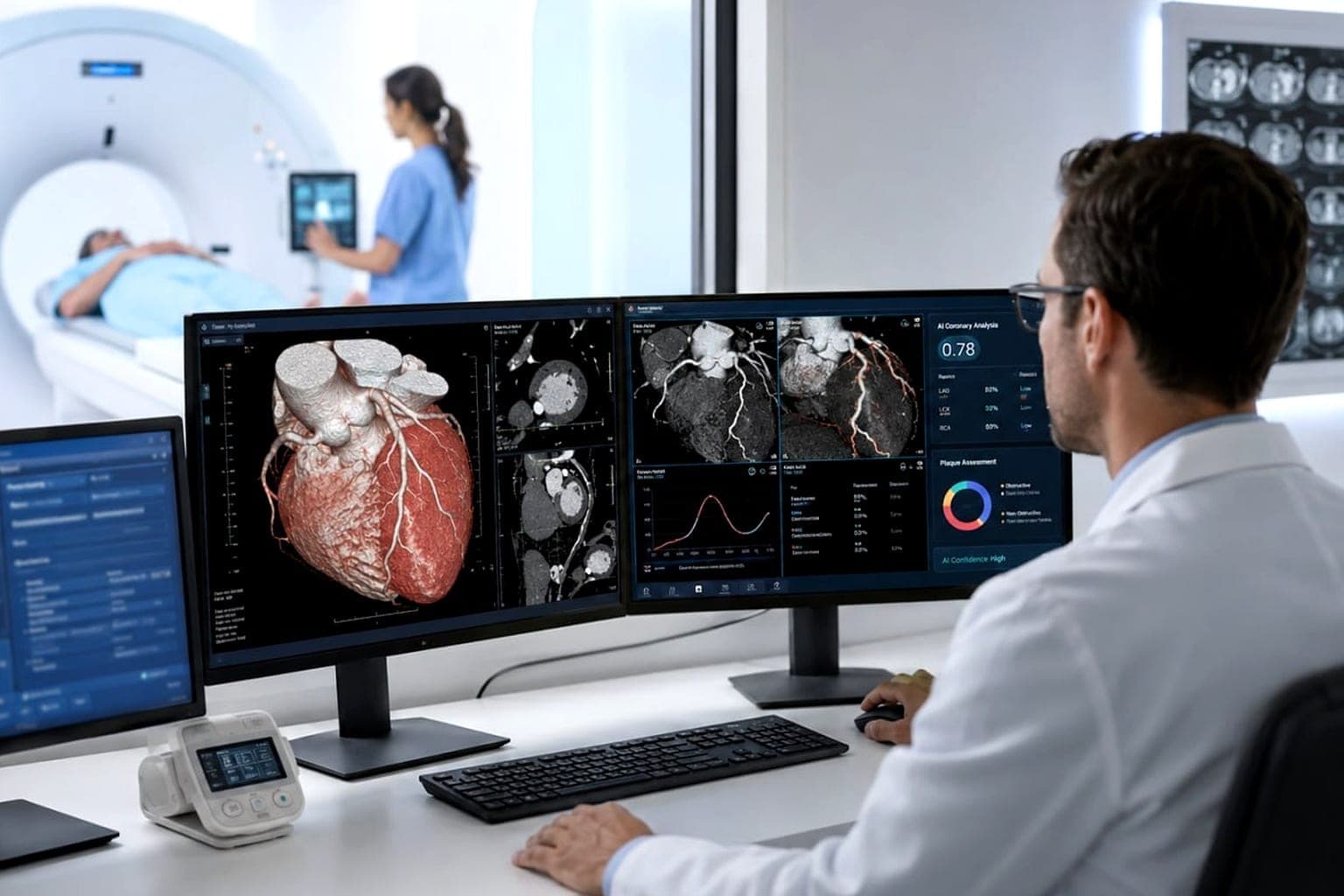
Cardiac CT Angiography in Seminole, FL
AMI’s AI Heart Scan is a cardiac CT angiogram (CCTA) with Cleerly AI plaque analysis that maps every artery in your heart, quantifying soft plaque, hard plaque, and stenosis — the data a calcium score and stress test cannot give you.
What Is a CT Cardiac Angiography with AI Analysis?
A coronary CT angiogram (CCTA) is a non-invasive cardiac CT scan that produces highly detailed 3D images of the coronary arteries — the blood vessels that supply oxygen to the heart muscle. After IV iodine contrast is given, the scanner captures the heart in motion using a fast, gated sequence. At AMI, every CCTA is processed through Cleerly — an FDA-cleared AI platform that quantifies and characterizes coronary plaque (soft, fibrous, calcified) and grades stenosis at every segment of every artery. The result is a personalized, vessel-by-vessel risk map that goes far beyond traditional calcium scoring or stress testing — and identifies the very plaque types most likely to rupture and cause a heart attack.
What Can CT Cardiac Angiography with AI Analysis Diagnose?
- Coronary artery disease (early and advanced)
- Soft plaque — the high-risk, vulnerable plaque most likely to rupture
- Calcified (hard) plaque burden and Agatston calcium score
- Coronary artery stenosis (narrowing) graded segment by segment
- Anomalous coronary artery anatomy
- Chest pain evaluation in low-to-intermediate risk patients
- Non-cardiac causes of chest pain (visible on the same scan)
AI Heart Scan vs. Calcium Score vs. Stress Test
Not all cardiac tests are equal. Choosing the right one depends on your risk profile — ask your cardiologist or primary care physician which is right for you.
| Feature | AMI ✓ | Calcium Score | Stress Test |
|---|---|---|---|
| What It Detects | All plaque types (soft, mixed, calcified) + stenosis grade | Calcified (hard) plaque only | Flow-limiting blockages already present |
| Detects Soft Plaque | Yes — the high-risk plaque most likely to rupture | No | No |
| IV Contrast Required | Yes (iodine-based) | No | No |
| Radiation | Low-dose CT (a few mSv) | Very low-dose CT | Nuclear stress: moderate; exercise: none |
| AI Analysis | Cleerly AI — FDA-cleared, vessel-by-vessel plaque map | None — single Agatston score | None |
| Exam Time (on site) | 30 – 45 minutes total | ~15 minutes | 2 – 4 hours |
| Results to Physician | 48 hours — radiologist + Cleerly AI report | Same or next day | Same day (cardiologist review) |
| Best For | Intermediate-risk patients; ruling in/out significant disease | Low-risk screening baseline | Evaluating symptoms under exertion |
How to Prepare for Your CT Cardiac Angiography with AI Analysis
- 1Avoid caffeine for 24 hours before your scan (caffeine raises heart rate)
- 2Skip Viagra/Cialis for 24–48 hours — these interact with nitroglycerin we may give
- 3Avoid heavy meals 4 hours before the scan; clear liquids and routine medications are usually OK
- 4Continue beta blockers and other heart medications unless told otherwise
- 5Tell us about iodine allergy, kidney disease, diabetes, or pregnancy
- 6Plan for ~45 minutes total (IV placement, heart-rate optimization, scan)
- 7If using insurance, bring your physician's order for the cardiac CT angiogram
What to Expect During Your CT Cardiac Angiography with AI Analysis
Intake & IV Placement
You'll change into a gown and a small IV is placed for contrast. We attach EKG leads to gate the scan to your heartbeat.
Heart-Rate Optimization
A clear, sharp CCTA requires a slow, steady heart rate (usually under 65 bpm). If yours is elevated, we administer a short-acting beta blocker. A small dose of sublingual nitroglycerin is also given to dilate the arteries — most patients tolerate both very well.
The CT Scan
You lie on the CT table. The actual scan takes only seconds — you'll be asked to hold your breath briefly. As contrast is injected, you may feel a brief warm sensation or metallic taste — completely normal.
Cleerly AI Analysis
Your images are sent to Cleerly's FDA-cleared AI platform, which analyzes every coronary segment for plaque type, plaque volume, and stenosis grade. The result is a color-coded, vessel-by-vessel report.
Cardiologist & Radiologist Review
A board-certified radiologist interprets the CT, and the Cleerly report is delivered alongside it — typically within 48 hours, available to share with your cardiologist or primary care physician.
Frequently Asked Questions
A calcium score measures only calcified (hardened) plaque — it cannot see soft plaque, the type most likely to rupture and cause a heart attack. The AI Heart Scan is a contrast cardiac CT angiogram (CCTA) that maps the entire coronary tree, with Cleerly AI quantifying soft plaque, calcified plaque, and exact stenosis at every segment.
A stress test detects existing flow-limiting blockages by stressing the heart and watching for symptoms or ECG changes. It can miss meaningful disease that hasn't yet caused a critical narrowing. CCTA directly visualizes plaque — including non-obstructive disease that still raises future heart-attack risk. Cardiologists increasingly use CCTA as a first-line test for stable chest pain.
Cleerly is an FDA-cleared software platform that uses artificial intelligence to analyze CCTA images. It segments every coronary artery, characterizes plaque as soft, fibrous, or calcified, calculates plaque volume, and grades stenosis percentage. The output is a personalized, color-coded report — essentially a Google Maps view of your coronary arteries — that gives your cardiologist far more actionable data than a traditional read alone.
Modern cardiac CT uses dose-reduction protocols that have dramatically lowered radiation exposure compared to earlier generations. A typical CCTA delivers a few millisieverts — comparable to other diagnostic CT exams and far less than a cardiac catheterization. The benefit of identifying high-risk plaque before a heart attack typically outweighs this exposure.
Iodine-based IV contrast is what makes the coronary arteries visible on CT. Without it, the arteries cannot be reliably mapped. If you have a known iodine allergy or significant kidney disease, let us know — alternatives or premedication protocols may be available.
Adults with unexplained chest pain or shortness of breath, intermediate cardiovascular risk, a family history of premature heart disease, abnormal calcium scores, diabetes, or high cholesterol — or anyone whose physician recommends advanced cardiac imaging. It is not typically recommended when a very high pretest probability makes direct catheterization the better first test.
The cardiac CT angiogram (CCTA) behind our AI Heart Scan is increasingly covered by Medicare and major commercial insurers when medically indicated, particularly for stable chest pain. The Cleerly AI plaque analysis may be billed separately. Call (727) 398-5999 to verify your benefits or for self-pay pricing.
Self-pay patients do not need a referral. Our physician reviews your request the same day — most self-pay patients are seen same day or added as a walk-in. If using insurance, a physician order is required. See the dedicated booking page below for pricing details and scheduling, or call (727) 398-5999.
Also Consider
Book this scan
Ready to book your heart scan? See pricing & details →
Includes pricing, sample report, FAQs, and online appointment request.
See our transparent self-pay pricing (up to 75% less than hospital rates), or check accepted insurance plans.
Ready to Schedule Your CT Cardiac Angiography with AI Analysis?
Call us or book online. We'll get you scheduled quickly.