

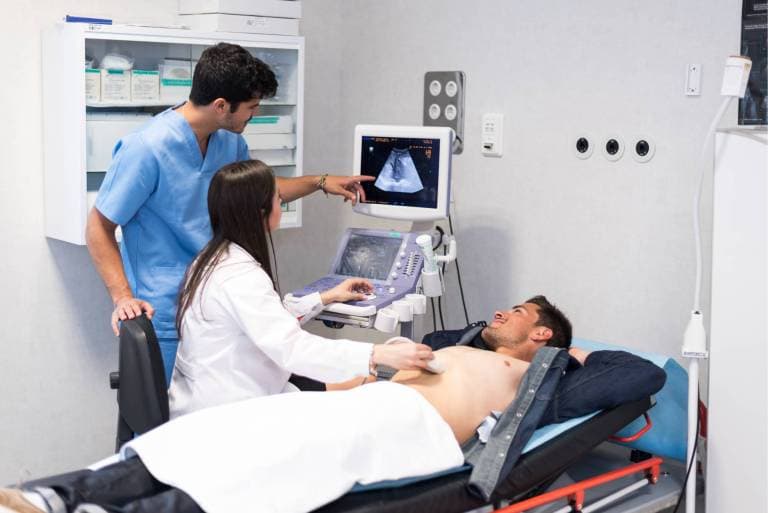
Echocardiogram — See Your Heart in Motion
An echocardiogram uses ultrasound to create real-time moving images of your heart, helping your doctor evaluate heart function, valve performance, and blood flow — with zero radiation.
What Is an Echocardiogram?
An echocardiogram (often called an "echo") is a specialized ultrasound of the heart. It uses sound waves to produce real-time, moving images showing how your heart chambers and valves are functioning, how blood flows through your heart, and the overall strength of your heart muscle. It's the primary tool cardiologists use to evaluate heart health — completely non-invasive and radiation-free.
What Can Echocardiogram Diagnose?
- Heart valve problems (leaking or narrowing)
- Heart muscle weakness (cardiomyopathy)
- Congestive heart failure
- Heart murmurs
- Congenital heart defects
- Pericardial effusion (fluid around the heart)
- Blood clots in the heart
- Overall cardiac function assessment
How much does an echocardiogram cost in Seminole?
One published self-pay price, read by a board-certified cardiologist. Hospital outpatient echocardiograms are commonly billed at $1,000 to $3,000 before insurance.
- Echocardiogram (transthoracic, with Doppler)About 45 minutes, no radiation$250
- Coronary calcium scoreCT scan for plaque and heart-disease risk$99
- Coronary CT angiographyBlockages and plaque, with contrast$395
With insurance, your cost is your plan's copay or deductible; we verify benefits before your visit. Eligible self-pay exams do not need a referral, and HSA/FSA cards are accepted. All prices →
Echo, calcium score or CT angiography: which heart test?
They answer different questions. Many patients have an echo and a calcium score; your doctor or cardiologist decides.
Echocardiogram
How well the heart pumps, the four valves, chamber size and fluid around the heart. Ultrasound, no radiation. $250.
Seminole
Calcium score
Plaque in the coronary arteries and your long-term risk of a heart attack. 10-minute CT, no contrast. $99.
Seminole
Coronary CT angiography
Narrowing or blockage of the coronary arteries, with contrast. Often ordered for chest pain. $395.
Seminole
How to Prepare for Your Echocardiogram
- 1No special preparation is needed for a standard echocardiogram
- 2Wear a comfortable, two-piece outfit (you'll undress from the waist up)
- 3You may eat and drink normally before the exam
- 4Continue taking all medications as prescribed
- 5Arrive 15 minutes early; bring insurance card and physician's order if using insurance
What to Expect During Your Echocardiogram
Preparation
You'll change into a gown from the waist up. Small electrode stickers will be placed on your chest to monitor your heart rhythm during the exam.
The Echocardiogram
You'll lie on your left side. The sonographer applies warm gel to your chest and uses a transducer to capture images of your heart from several angles. You'll hear a "whooshing" sound — that's your blood flow being measured.
Doppler Assessment
Color Doppler technology maps blood flow direction and speed through your heart. This helps detect valve leaks, narrowing, and abnormal flow patterns.
After the Exam
Electrodes and gel are removed. Resume all normal activities immediately. Your cardiologist or physician will receive results in 48–72 hours.
Frequently Asked Questions
An EKG (electrocardiogram) records your heart's electrical activity using electrodes. An echocardiogram uses ultrasound to create actual images of your heart structure and function. They test different things — your doctor may order one or both.
No. It's completely painless. You'll feel the transducer pressing gently on your chest with gel. Some slight pressure is needed for clear images, but it shouldn't be uncomfortable.
A standard transthoracic echocardiogram takes about 25–40 minutes. The complete echo with Doppler and color flow provides the most comprehensive assessment of heart function.
Self-pay patients do not need a referral. Our physician reviews your request the same day — most self-pay patients are seen same day or added as a walk-in. If you plan to use insurance, a physician's order from your primary care doctor or cardiologist is still required. Call (727) 398-5999 with questions.
Your doctor may order an echo if you have a heart murmur, shortness of breath, chest pain, high blood pressure with suspected heart involvement, a history of heart valve problems, or unexplained fatigue. It's also used to monitor heart failure and assess heart function before certain surgeries.
Yes, most insurance plans cover echocardiograms when ordered by a physician for a medical indication. We verify your benefits before your appointment. Self-pay pricing is also available — call (727) 398-5999.
Our board-certified cardiologist interprets your echocardiogram and sends results to your referring physician in 48–72 hours. For urgent cases, stat reads are available the same day.
No special preparation is needed. Eat and drink normally, take your regular medications, and wear a comfortable two-piece outfit since you'll undress from the waist up. Arrive 15 minutes early to complete paperwork.
A self-pay echocardiogram at AMI is $250, including the cardiologist's reading. Hospital outpatient departments in Pinellas County commonly bill $1,000 to $3,000 for the same test.
With insurance, a physician's order is required and we handle the authorization. Self-pay patients do not need a referral. Call (727) 398-5999 and our team will confirm what applies.
For self-pay, same-day appointments are often available in Seminole; with insurance, it is usually the same week. Results go to you and your doctor in 48–72 hours.
Book this scan
Book a $250 self-pay echocardiogram →
Includes pricing, sample report, FAQs, and online appointment request.
See our transparent self-pay pricing (up to 75% less than hospital rates), or check accepted insurance plans.
Ready to Schedule Your Echocardiogram?
Call us or book online. We'll get you scheduled quickly.