
Shoulder MRI in Seminole, FL
A shoulder MRI is the most detailed scan for shoulder pain, rotator cuff tears, labral (SLAP) tears, and impingement. No radiation, no referral needed for self-pay, and same-week scheduling at our Seminole, FL imaging center.
What Is a Shoulder MRI?
A shoulder MRI uses a strong magnetic field and radio waves — no radiation — to produce detailed cross-sectional images of the shoulder joint: the rotator cuff tendons (supraspinatus, infraspinatus, subscapularis, teres minor), the labrum, the biceps tendon, the joint capsule, the cartilage, and the surrounding bone. It is the single most accurate test for evaluating shoulder pain and weakness, because it shows the soft-tissue structures — tendons, the labrum, and the cartilage — that an X-ray cannot see. Most shoulder MRIs are performed without contrast; an MR arthrogram (contrast injected into the joint) is sometimes used to better evaluate labral tears such as a SLAP lesion or suspected instability.
What Can Shoulder MRI Diagnose?
- Rotator cuff tears and tendinopathy
- Labral tears, including SLAP lesions
- Shoulder impingement and bursitis
- Biceps tendon tears and tendinitis
- Frozen shoulder (adhesive capsulitis)
- Shoulder instability and dislocation damage (Bankart, Hill-Sachs)
- Arthritis and cartilage damage of the shoulder
- Bone bruises, stress fractures, and AC joint problems
Shoulder MRI vs. X-Ray vs. Ultrasound for Shoulder Pain
For rotator cuff, labral, and tendon injuries, MRI is the gold standard because it shows the full joint in detail.
| Feature | AMI ✓ | X-Ray | Ultrasound |
|---|---|---|---|
| Shows rotator cuff & labrum | Yes — full soft-tissue detail | No — bone only | Cuff only, operator-dependent |
| Evaluates labral (SLAP) tears | Yes (best with arthrogram) | No | No |
| Radiation | None | Low dose | None |
| Best for | Rotator cuff, labrum, impingement, biceps | Fractures, arthritis | Quick cuff/bursa look |
| Self-pay from | $295 | $50 | From $195 |
How to Prepare for Your Shoulder MRI
- 1Remove all metal jewelry, piercings, watches, and belts
- 2Tell our technologist about any implants, shoulder hardware, pacemakers, or surgical clips
- 3Wear comfortable clothing without metal zippers, buttons, or underwire
- 4Arrive 15 minutes early to complete intake and safety screening
- 5If using insurance, bring your insurance card and physician's order
- 6If an arthrogram is ordered, allow extra time for the contrast injection
What to Expect During Your Shoulder MRI
Check-In & Safety Screening
You'll complete a safety questionnaire about any metal or implants in your body. Our technologist reviews your history and confirms which shoulder is being imaged and whether an arthrogram is ordered.
Positioning
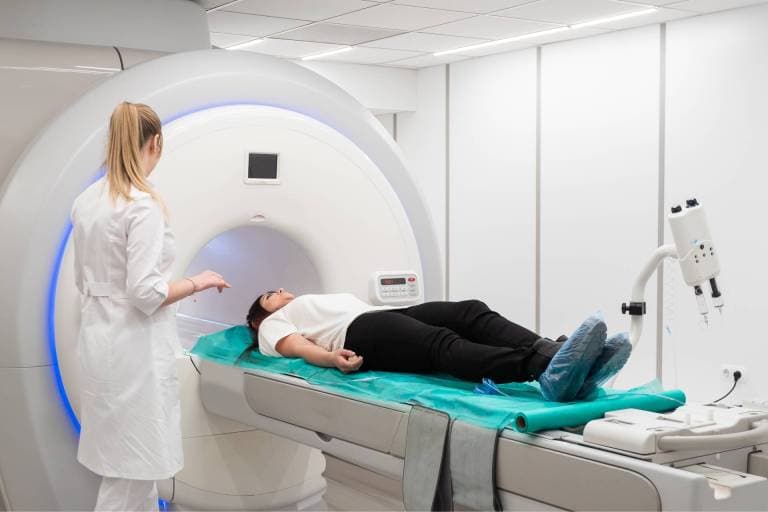
You'll lie on a padded table with your arm positioned comfortably and a coil placed over the shoulder being scanned. We'll give you earplugs or headphones with music to keep you comfortable.
The Scan
You'll hear rhythmic tapping and humming — completely normal. The key is to keep your shoulder as still as possible so the rotator cuff and labrum are sharp. A typical shoulder MRI takes 30–45 minutes.
After Your Scan
You can drive, return to work, and resume all normal activities immediately. A board-certified radiologist reads your images and delivers results to your physician within 48 hours; stat reads are available for urgent cases.
Frequently Asked Questions
Our self-pay shoulder MRI starts at $295 without contrast — up to 75% less than typical hospital pricing. If an MR arthrogram (contrast injected into the joint) is needed to evaluate a labral tear, the price is higher. Call (727) 398-5999 for an exact quote, or see our transparent self-pay pricing page.
Self-pay patients do not need a referral. Our physician reviews your request the same day — most self-pay patients are seen same day or added as a walk-in. If you plan to use insurance, a physician's order is still required, and we will verify your benefits before your appointment. Call (727) 398-5999 and we'll get you scheduled.
Most shoulder MRI exams take 30–45 minutes. A standard non-contrast scan is on the shorter end; an MR arthrogram with a contrast injection adds time for the injection and a brief wait. We'll give you a time estimate when you schedule.
Yes. For rotator cuff tears, labral tears, impingement, and biceps tendon problems, MRI is the gold-standard test because it shows the tendons, labrum, and cartilage that X-ray and CT cannot. X-ray is still useful for fractures, arthritis, and bone alignment, but for the most common causes of shoulder pain, MRI gives the clearest answer.
An MR arthrogram is a shoulder MRI where contrast dye is injected directly into the shoulder joint before scanning. It outlines the labrum and capsule, making subtle labral tears (like a SLAP lesion) and instability much easier to see. It's used in specific cases — your physician and our radiologist decide whether a standard MRI or an arthrogram is the right test for your symptoms.
Often yes — most modern shoulder hardware is MRI-conditional, though metal can cause local image distortion near the implant. Always tell our team about any shoulder replacement, screws, anchors, pacemakers, or surgical clips during safety screening so we can confirm it's safe and adjust the technique.
We understand MRI anxiety. Our wide-bore MRI gives extra space and we offer music during your scan. Because the shoulder sits to one side, positioning can sometimes be adjusted for comfort. If you're very anxious, we also have an Open MRI option, or your doctor may prescribe a mild sedative — let us know when you schedule.
Also Consider
High-Field 1.5T MRI →
Our standard high-field MRI for joints, brain, spine, and more
3 Tesla MRI →
Need ultra-high resolution of the rotator cuff and labrum? See our 3T MRI
Knee MRI →
Another common sports-injury joint scan — ligaments and meniscus
MRI Without a Referral →
Self-pay patients can book a shoulder MRI with no referral needed
See our transparent self-pay pricing (up to 75% less than hospital rates), or check accepted insurance plans. Comparing prices? Read our guide to MRI costs in Florida.
Ready to Schedule Your Shoulder MRI?
Call us or book online. We'll get you scheduled quickly.